CRYING: an ESSENTIAL PROCESS?
This blog post may seem a tad obvious, but you would be surprised how many individuals do not allow themselves to fully experience their emotions e.g. crying.

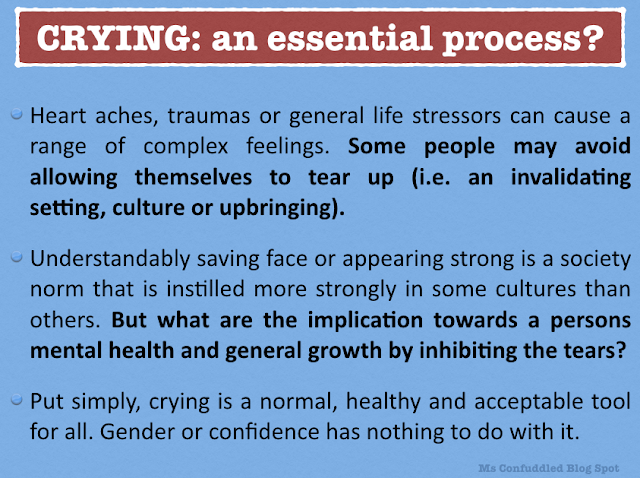
Currently society dictates when, where and what is a suitable situation to cry about. The implicit social rule book of how to feel is utter madness e.g. men should cry less or it is a weak trait.
Crying is commonly viewed as "too" emotional, erratic and unreliable, so people just suck it up, accept it quickly and carry on with work, life and stuff....

What happens when we don't cry enough? When we don't allow ourselves to feel enough? What happens when we just keep moving forward in this fast-paced world? What happens when we choose to bury any emotional weaknesses or uncontrollable feelings deep down in our subconscious and just crack on?

IF crying is one toolset to process emotions, then it would be silly not to do so. The psychological process to form tears allows feelings to be appropriately channelled. The aim is to NEVER suppress your emotions in the unconscious mind, but allow them to surface for a period of time, consciously (even if it feels annoying or uncomfortable).


It is common in the working world for people to inhibit tears to reduce their own personal emotional expression e.g. by distractions. This method is used to avoid addressing what it is (e.g. the emotions felt).
When at work we don't say "I feel like crying" to our managers or our teachers; most choose to ride above the waves of emotions. Over time this can add a heavy load to the unconscious mind. We cannot see it grow visually but may feel it intensify like a ticking time bomb.


So why do some people instinctively avoid crying? Why does society make us feel it (crying or expression of negative emotions) is generally a weak and unnecessary thing to do?
Who are they to decide when a person should or should not openly feel their own subjective emotions?


So how does the simple choice of not expressing emotions fully impact a person's mental health?
Can it really be a significant risk factor towards depression, PTSD or some other mental challenge of the mind? YES!


Avoidance (to cry or feel emotions honestly) is a quick & dirty route via the thalamus. Thus it is not fully processed through the hippocampus (conscious memory). Hard science argues that avoidance is a high risk factor for poor mental health.

So we understand the brain areas and the cognitive hypothesised models to help explain why crying is a key process.... but what about the wider meaning of it all?
You all have the ability for a greater awareness, a higher level of autonomy and implicit freedom. So do I choose to place my emotions in a mental box that starts to overflow? Or do I open it up, accept them as they are and then move forward?


Sometimes even though we feel we should be aware of how to do something, it is not always so easy. So here are some tips that may help you let it all out....


When dealing with your own emotions, it may be best not to focus on "what is the most socially acceptable way to feel".
Sometimes you may need to listen NOT to everyone else, but just to your "own" instincts of what may work for you.

Crying is just one way to express your emotions e.g. sadness, shock and confusion. BUT it is NOT the only way. Just aim to let it out in your own way truthfully & try not to replace anything you may feel with something else.
I hope this blog post helps anyone who may be going through a tough time (you may not know consciously why). Please remember however small or trivial it may seem, you are worth the time to allow yourselves ..... to let it out.

Currently society dictates when, where and what is a suitable situation to cry about. The implicit social rule book of how to feel is utter madness e.g. men should cry less or it is a weak trait.
Crying is commonly viewed as "too" emotional, erratic and unreliable, so people just suck it up, accept it quickly and carry on with work, life and stuff....

What happens when we don't cry enough? When we don't allow ourselves to feel enough? What happens when we just keep moving forward in this fast-paced world? What happens when we choose to bury any emotional weaknesses or uncontrollable feelings deep down in our subconscious and just crack on?

IF crying is one toolset to process emotions, then it would be silly not to do so. The psychological process to form tears allows feelings to be appropriately channelled. The aim is to NEVER suppress your emotions in the unconscious mind, but allow them to surface for a period of time, consciously (even if it feels annoying or uncomfortable).


It is common in the working world for people to inhibit tears to reduce their own personal emotional expression e.g. by distractions. This method is used to avoid addressing what it is (e.g. the emotions felt).
When at work we don't say "I feel like crying" to our managers or our teachers; most choose to ride above the waves of emotions. Over time this can add a heavy load to the unconscious mind. We cannot see it grow visually but may feel it intensify like a ticking time bomb.


So why do some people instinctively avoid crying? Why does society make us feel it (crying or expression of negative emotions) is generally a weak and unnecessary thing to do?
Who are they to decide when a person should or should not openly feel their own subjective emotions?


So how does the simple choice of not expressing emotions fully impact a person's mental health?
Can it really be a significant risk factor towards depression, PTSD or some other mental challenge of the mind? YES!


Avoidance (to cry or feel emotions honestly) is a quick & dirty route via the thalamus. Thus it is not fully processed through the hippocampus (conscious memory). Hard science argues that avoidance is a high risk factor for poor mental health.

So we understand the brain areas and the cognitive hypothesised models to help explain why crying is a key process.... but what about the wider meaning of it all?
You all have the ability for a greater awareness, a higher level of autonomy and implicit freedom. So do I choose to place my emotions in a mental box that starts to overflow? Or do I open it up, accept them as they are and then move forward?


Sometimes even though we feel we should be aware of how to do something, it is not always so easy. So here are some tips that may help you let it all out....


When dealing with your own emotions, it may be best not to focus on "what is the most socially acceptable way to feel".
Sometimes you may need to listen NOT to everyone else, but just to your "own" instincts of what may work for you.


Crying is just one way to express your emotions e.g. sadness, shock and confusion. BUT it is NOT the only way. Just aim to let it out in your own way truthfully & try not to replace anything you may feel with something else.
I hope this blog post helps anyone who may be going through a tough time (you may not know consciously why). Please remember however small or trivial it may seem, you are worth the time to allow yourselves ..... to let it out.


